|

Versione italiana
GO
TO WWW.PALAZZOFIZZAROTTI.IT
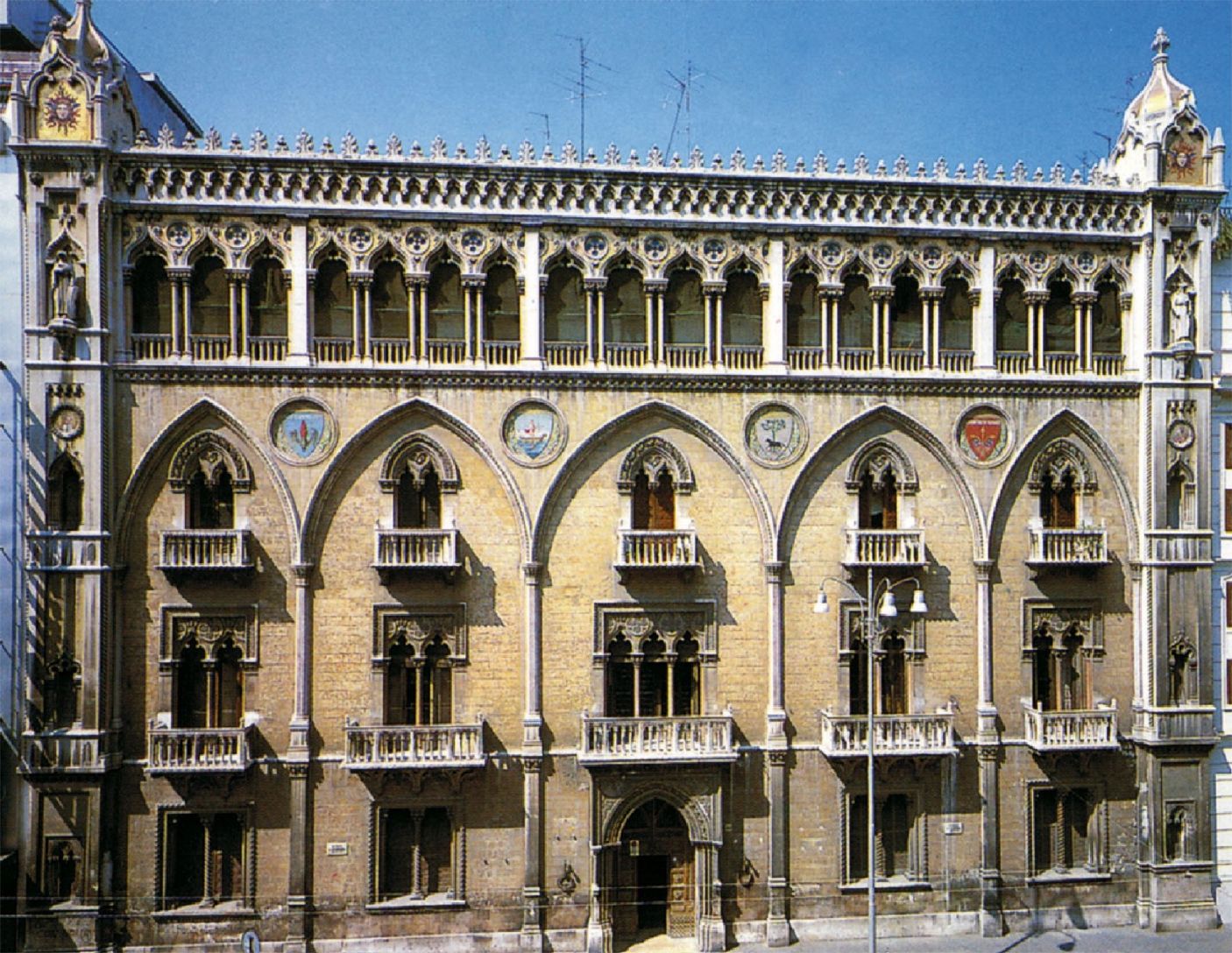
The Fabulous Façade Overlooking
the Exclusive Avenue “Corso Vittorio Emanuele II.”
The
real estate property is a Gothic-Venetian style Palace, built between the end of the l9th
century and the beginning of the 20th. It was designed by the noteworthy
architects Bernich and Corradini who employed fine artisans and artists,
sculptors, decorators, mosaic inlayers, iron and gold smiths and Murano
glass-makers to embellish the building. The Palace extends over a total
covered area of about 3000 square metres and has an internal courtyard
featuring a marvellous Neptune Fountain. The Palace is composed of the
ground floor and three other storeys, soaring to a height of 21.40 metres.
The last storey is ornamented with a splendid open gallery with ogival
arches and a colonnade, supporting a fine, valuable cornice. All the halls,
including The 14th Century Hall, The Pink Hall, The Arts and
Crafts Hall and The Fireplace Hall have been perfectly conserved and
restored. They are finely decorated with stuccoes and glazes and a
multitude of inlay work. The fabulous authentic artwork enraptures the eye
of the beholder, instilling feelings of awe. The “Palazzo” outstands
all the other city buildings owing to both its excellent, refined
workmanship, permeating throughout the building, and its unique Eclectic
style, clearly exemplified by its neo-Gothic Venetian architecture. The
majestic and monumental “Palazzo Fizzarotti”, situated in the heart of
Bari, is perfect for housing highly prestigious institutions.Classe
energ. G.
The ground
floor consists
of large halls with high dome ceilings. The halls are finely embellished
with excellent glass artwork, window-frames, internal doors and boiseries.
The first
storey
is of particular beauty and elegance due to the refined decorative styles
and fabulous fixed wall furnishings.
The rooms reflect the Eclectic movement which has left remarkable
examples in Italy, although many examples have been destroyed, and Central
Europe. The first storey includes four central sitting rooms of which
three are interconnected, and the fourth can be accessed via the waiting
room. These rooms, better described further on, are surrounded by six
other smaller rooms, decorated in various styles, typical of the Eclectic
period.
The second
storey has
been recently renovated and is composed of both large and smaller sitting
rooms with decorated ceilings. In
particular, the sitting room situated in the right wing displays a
wonderful Venetian floor and a central mosaic rose-window.
The third
storey has
also been luxuriously refurbished and has solid hardwood window frames and
doors, a Carrara marble floor, antique tapestries, air conditioning,
burglar and fire alarm system, fibre optic and internet connections,
switchboard telephone instalments. This last storey is characterised by a
monumental open arcade gallery, lining the entire façade of the Palace,
with ogival arches. Both the walls and the vaults are frescoed and the
floor is lain with fine marble. The arcaded gallery overlooks the city
scene of “Corso Vittorio
Emanuele II”, the city’s prime and exclusive avenue.
The “Palazzo
Fizzarotti” today is an elegant and prestigious cultural centre, hosting important national
and international events. It is also topic of very interesting studies of
the Eclectic style: in 2006, the building was the focal point in two
exhibitions and conferences on the well-known and highly accredited
architect Bernich who designed and built the “Palazzo Fizzarotti”, a
fine example of the “shining light” of the artistic Eclectic movement.
These exhibitions were held in Rome and Naples, and, in 2007, the city of
Bari will host other exhibitions and conferences on this topic.
The photograph
gallery displays the precious interiors and marvellous artistic details.
|

Main
Entrance and Monumental Staircase |

Family
Coat of Arms
|
|

The
14th Century Hall during a Reception
|

The 14th Century Hall
depicting scenes of the nuptial procession of the marriage of
Federick II of Swabia to Yolanda of Brienne.
|
|
The14th
Century Gothic Venetian Style Hall has
been well-preserved and is very striking. The north wall is adorned
with geometric decorations and a large three-mullioned French window
with marble columns and Venetian glass. The south wall has two
double French windows: the internal one is in cut glass, while the
external one is in leaden glass. The columns have arabesque capitals.
The floor is of polychrome beaten Venetian marble with pure gold
leaf mosaic inserts, representing heraldic arms and geometric
designs. Two large decorated marble sitting benches, each surmounted
by a Corradini triptych with pure gold leaf frames, line the east
and west walls. The triptychs represent historical scenes and events
of Apulia. The triptych on the west side depicts the entrance in
Brindisi of the nuptial procession of the Swabian Federick II’s
marriage to Yolanda of Brienne, whereas the one on the east wall
depicts the joyful disembarkation of the Venetian Doge Orseolus in
Bari after liberating the city from Saracen siege. The beauty of
this hall is enhanced by a Murano glass chandelier of exceptional
value: one of the largest ever manufactured, with a carved support
decorated in gold leaf.
|
|
The
Arts and Crafts Hall. The ceiling is completely decorated with stuccoes and glazes, depicting
symbols in praise of virtues and labour. This is in perfect harmony
with the surrounding walls lined with solid walnut wood boiseries
inlayed and decorated with pure gold leaves. Of particular beauty
are the framed paintings along the walls and the inlayed doors
studded with bronze medallions and golden frames. The walls above
the wood boiseries are strewn with canvas paintings, depicting the
economic cycle of Apulia: the harvesting of crops, their
transformation and trading of the products with near and middle
eastern countries. Industrialization is portrayed as the ultimate
source of wealth which gives rise to Art and Culture. The splendour
of the hall is enhanced by the precious chandeliers in golden
wrought iron and Murano glass. The furnishings include two finely
inlayed solid walnut benches.
|

The
Arts and Crafts Hall. The Marketplace and Trade |
|

The
Pink Hall or Mirror Hall
|
The
Pink Hall
is in keeping with the Rococo style. It features lacquered solid
wood windows and carved doors with cut glass and pure gold leaf
stuccoes. The floor is composed of beaten Venetian marble with
subtle, delicate designs, overlain with an Aubusson carpet from the
Royal Room in Versailles. The ceiling is ornamented with chubby
cherubs and fluffy romantic clouds in keeping with the Sans-Souci
style. The doors are surmounted by paintings depicting Angelica
Kauffman "Bergerie" scenes.
All the features in the hall have been well-conserved and
restored.
|
|
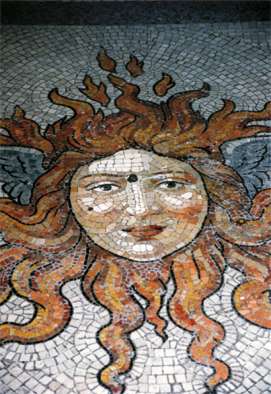
The
Mediterranean Sun “Mercury”: Symbol of Commerce and
Intelligence, ornamenting the centre of the floor in the Entrance
Hall on the first floor |

The Splendid and
Mystic Open Gallery Facing onto the Avenue “Corso Vittorio
Emanuele II”.
|
|
|
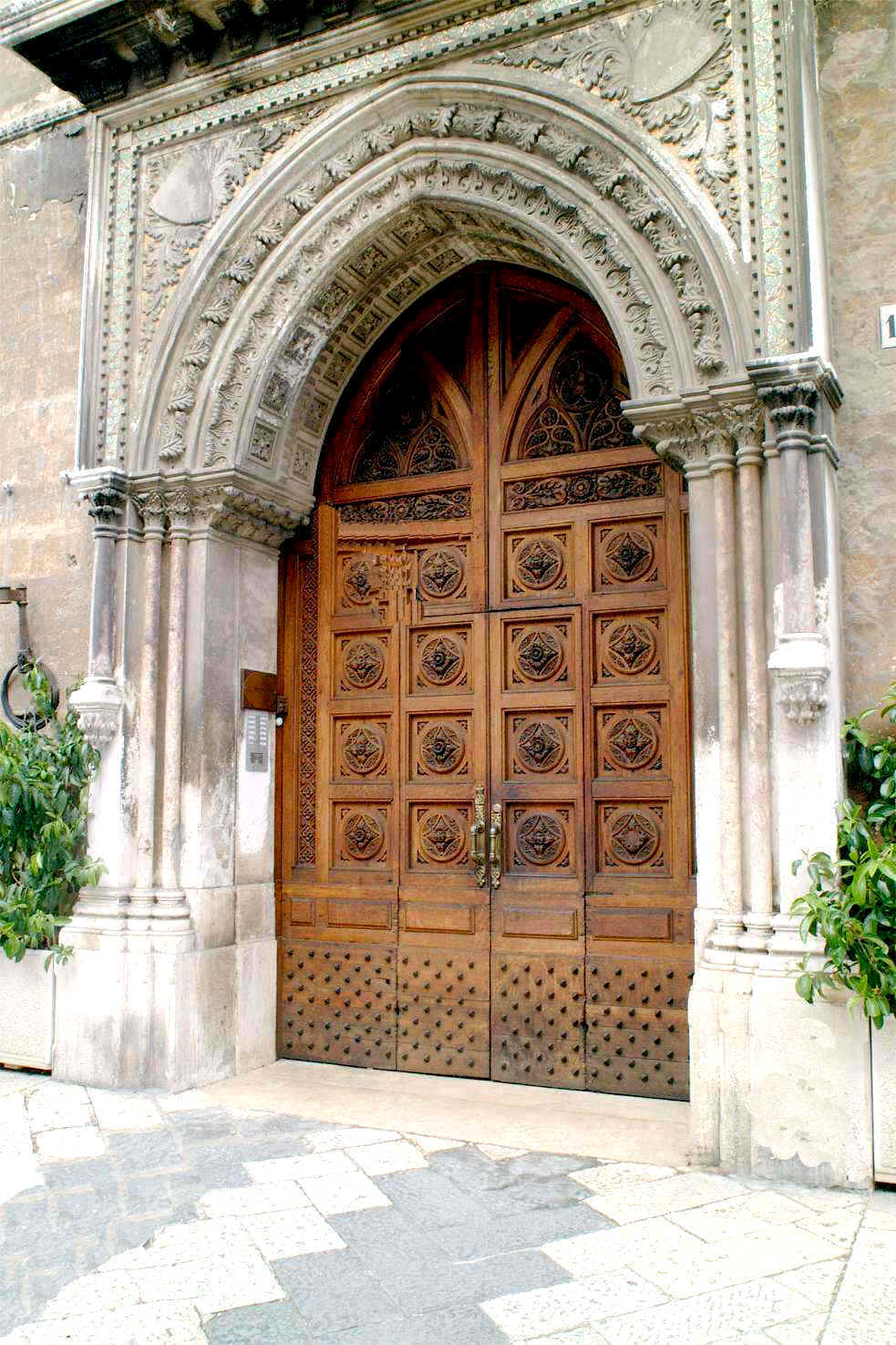

The finely carved wooden doors
The
Neptune Fountain
of the main entrance
in
the internal courtyard
|